



Mobility Resort Motegi Firework Festival

Fireworks Highlights
History of Fireworks
What is Hanabi?
In Japan, black powder was introduced along with firearms during the Sengoku period in the 16th century, and it began to be used not only for guns but also for signals such as "smoke signals" in battles. However, fireworks for viewing as we know them today appeared only after the Edo period began. The first fireworks festival in Japan is said to be the "Ryogoku River Opening Fireworks" held near Ryogoku Bridge in 1733.
Among the fireworks artisans active at that time were Tamaya Ichirobei and Kagiya Yahei, whose shop names are the origin of the cheers "Tamaya! Kagiya!" still heard at fireworks festivals today.
How to Make Fireworks
Japanese fireworks are the best in the world
Types of Fireworks
"Warimono" are fireworks where the shell explodes and scatters gunpowder pellets (stars) in all directions. The round and beautiful warimono represent Japanese fireworks.
"Pokamono," literally, are fireworks where the shell splits into two pieces with a pop in the sky, and the stars packed inside fall down. Among these, some move irregularly, and some have parachutes attached to the stars so they slowly descend from the sky.
There are also "small break shells," which contain many small fireworks shells inside a large one, and when the shell bursts, many small fireworks bloom. There are various types of fireworks, and understanding the types makes watching them even more enjoyable.
Chrysanthemum

Experience the essence of traditional fireworks techniques with a dazzling display of shooting stars and radiating patterns, depicting the chrysanthemum crest. When the colors of the petals change, it is called a "transforming chrysanthemum".
Peony

Similar to chrysanthemums, they bloom roundly but without dragging their tails, drawing light points and blooming flowers like peonies. They have a refreshing delicate beauty and brighter light than chrysanthemums. Among them, bright stars made with magnesium and other materials are called "Dahlia".
Yanagi
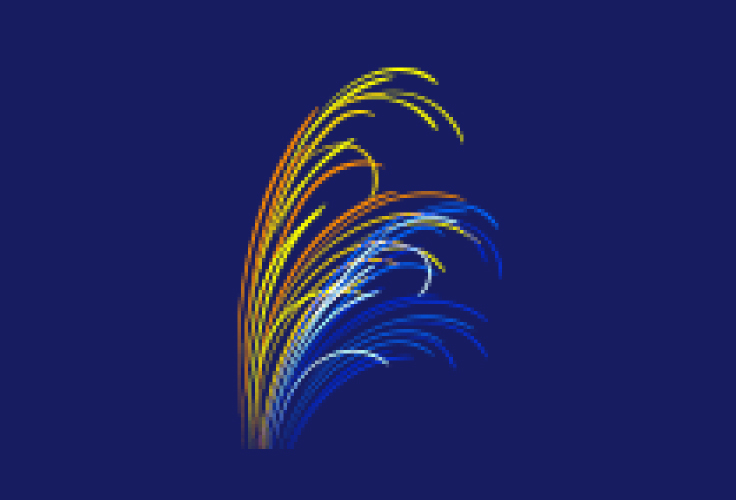
When the fireworks burst, the light falls from the sky like willow branches. Recently, there are various colored willows such as colored willows, and some change color when they fall.
Coconut

Looks just like a coconut tree with fireworks spreading out like coconut leaves. One of the representative fireworks of summer.
Star Mine
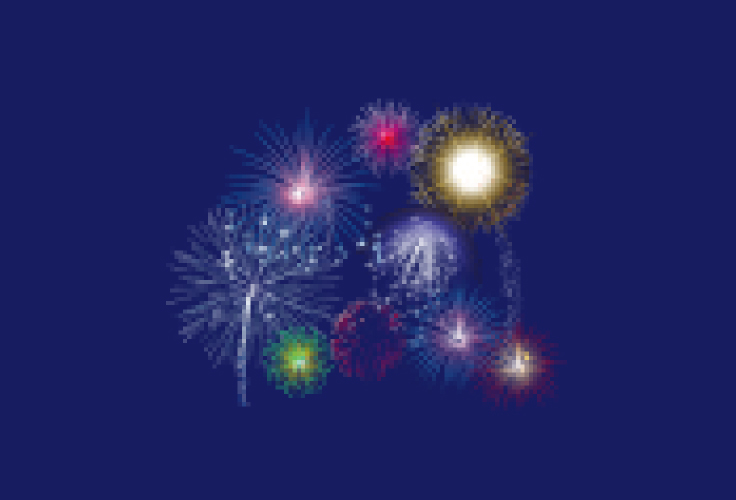
It is a combination of multiple fireworks that are continuously launched to create one theme.
Senrin

This is a firework that bursts open with multiple small balls packed inside, all at once, a moment after the firework ball explodes in the sky. Using small balls in various colors in the shape of chrysanthemums creates a "thousand chrysanthemums" effect.
Types (Saturn, Butterfly, etc.)

Fireworks that draw various shapes such as hearts, smiles, butterflies, and Saturn with dots and lines of light. Some fireworks are not spherical, so depending on the direction they open, they may be difficult to see.
Size and Types of Fireworks
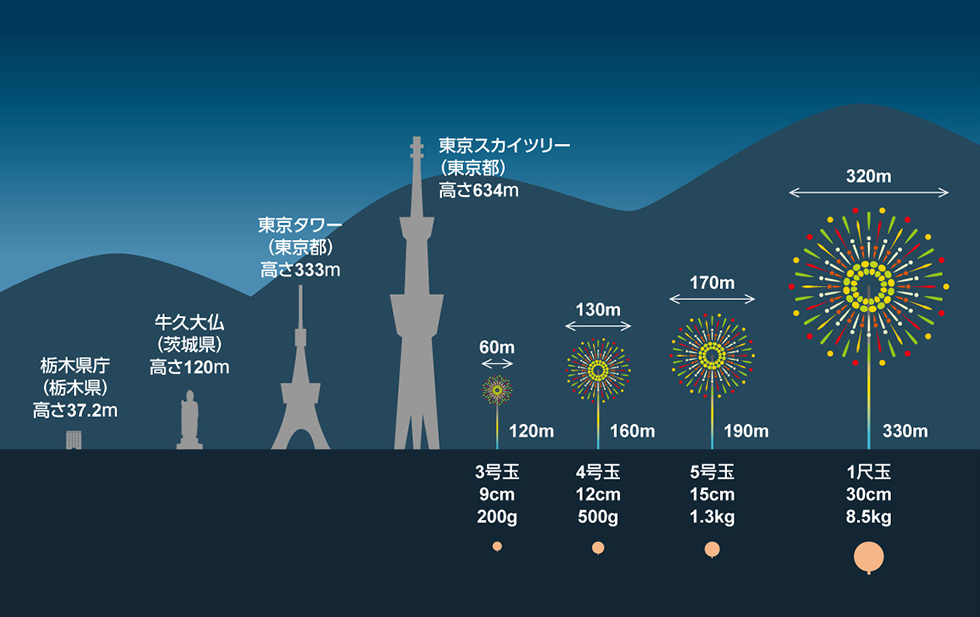
Firework shells are referred to by their size numbers such as 3, 4, and so on. The larger the firework shell, the larger the diameter of the firework burst in the sky becomes, reaching about 50 meters for a 2.5 size shell and about 320 meters for a size 10 shell.
While size is important, it is said that shells of size 5 or larger are best for creating more delicate colors and shapes. In fireworks competitions, the beauty and originality of 10-inch (1 shaku) shells are often contested.
Difference between foreign and Japanese fireworks
Japanese Fireworks to be Proud of in the World
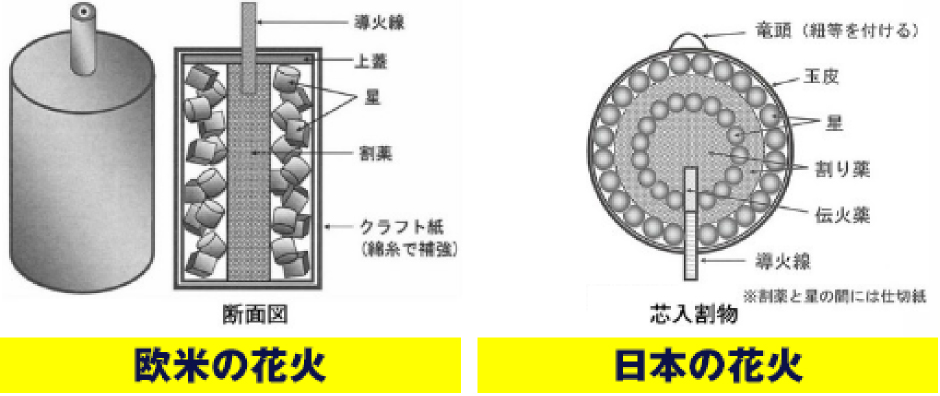
1. They bloom perfectly round, large, and orderly.
2. Each star of the petals changes color vividly.
3. It is possible to layer double and triple cores in concentric circles.
Also, Western-style cylindrical fireworks do not scatter in all directions in the sky, so they do not open into a perfect sphere like Japanese fireworks. However, some are characterized by connecting shells together, allowing them to change in multiple stages in the sky.
On the other hand, in Japan, from size 7 shells and larger, called "large shells," the sophisticated and magnificent expressive power becomes a prominent feature.
Also, Japanese fireworks artisans have perfected the technique of skillfully using Japanese paper to create double and triple concentric circles.
Fireworks with triple, quadruple, and even quintuple cores are the exquisite craftsmanship that Japan proudly presents to the world.
Good Fireworks Viewing
4 Tips for Watching a Great Fireworks Display
1. Good sitting position
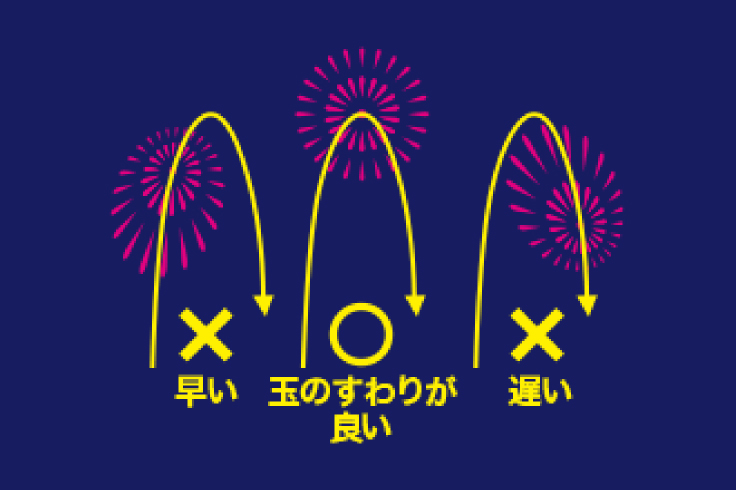
The firework shell opens at its peak.
Fireworks are ideally those that open at the highest point of the rising shell. When it opens at the moment the shell transitions from rising to falling, the stars open round without being affected by vertical forces. This is referred to as "the shell's position is good." If it opens while rising, it forms a fan shape, and if it opens while falling, the stars flow and do not form a beautiful spherical shape.
2. Good for Bon Festival
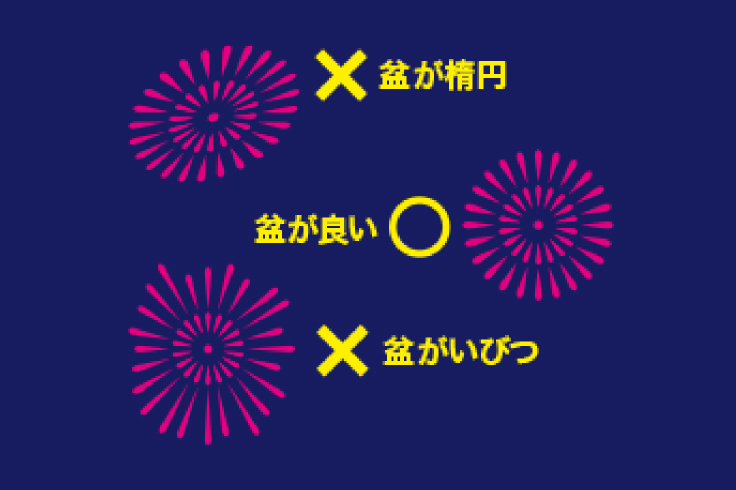
The expansion that matches the size of the ball, opening in a perfect spherical shape
The shape created when fireworks burst and stars scatter all at once is called a "bon". A large and beautiful perfect sphere is considered the best, and this is referred to as "good bon". If the opened shape is not a beautiful circle but appears as a distorted ellipse or an irregular shape, or if it does not have an expansion that matches the size of the ball, it cannot be considered good fireworks.
3. Good for stiff shoulders
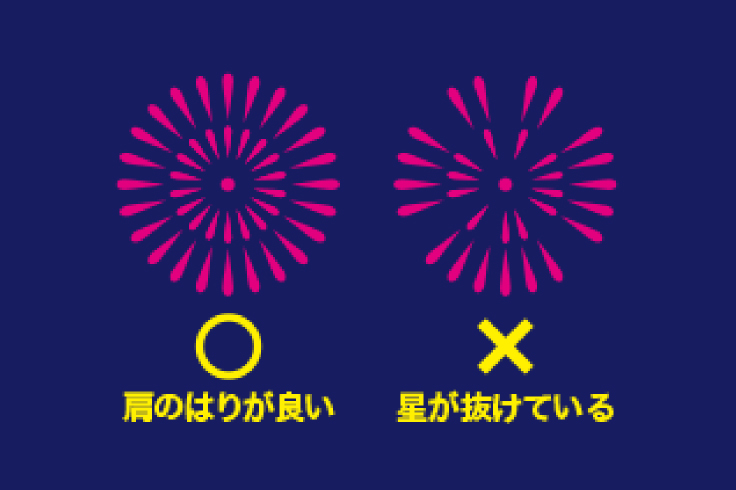
The stars scatter in a radial pattern, flying straight and forming a circle.
It is considered the best when stars fly radially from the firework shell, and it is said that "the shoulder's tension is good." It is not good if the stars swim unsteadily at the front, fly to unexpected places, or if there are "missing stars" that escape from where they should be without being ignited, resulting in a sparse display.
4. Evenly aligned disappearing mouth
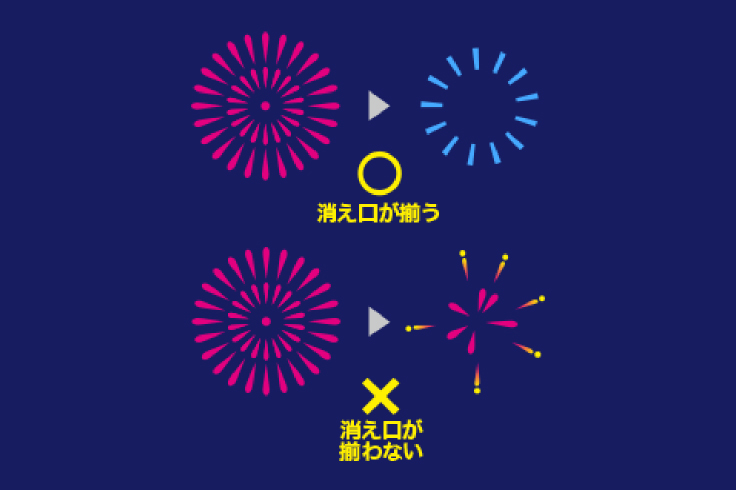
The moment when all the stars suddenly disappear.
Fireworks are greatly influenced by the timing of the stars' disappearance. Ideally, all the stars should change color and burn out simultaneously. The moment when the stars burn out is called the "disappearance point," and when countless stars shoot out radially and disappear all at once without going out individually, it tightens the fireworks and gives a more beautiful impression. This is referred to as "aligning the disappearance points." Additionally, in fireworks where the colors change while the stars are flying, it is considered good if those colors also change simultaneously.
Cooperation: Japan Fireworks Association
Citation: Introduction to Fireworks
